Reliable support
Fast support, warranty service and easy returns. Lifetime guarantee on our wooden products.
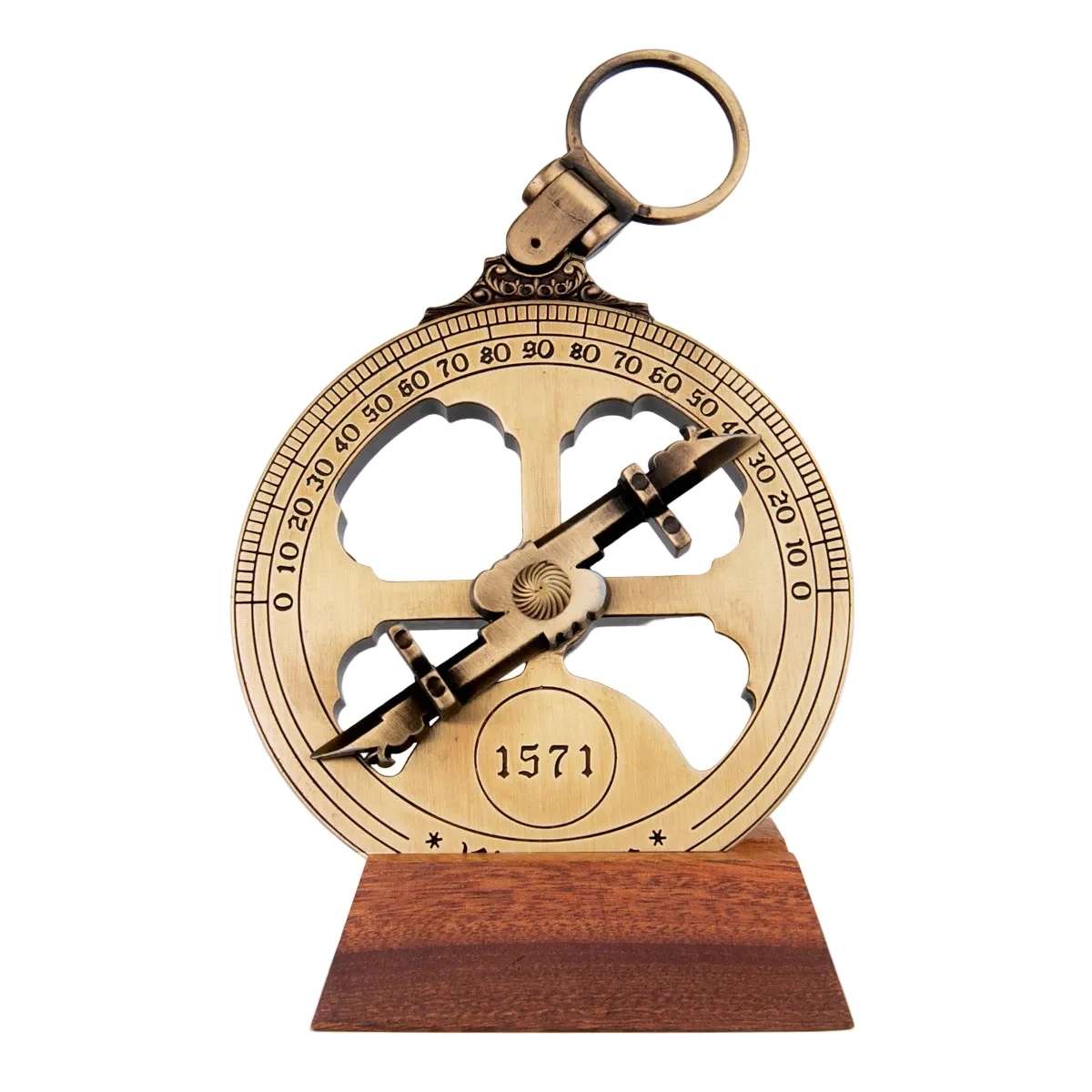
Replica of a 16th-century nautical astrolabe, reference H23, Hemisferium brand
Used to measure the altitude of the Sun or a star and calculate latitude from it
Suspension ring, graduated scale around the edge, and a rotating alidade with sighting vanes
Maximum height 15 cm, diameter 10 cm, thickness 10 mm
Zamac alloy with a brass finish, lacquered and oven-cured. Sapeli wood base, stained with natural wax and polished.
Instructions with history and usage
$126.99 $113.99
Product code: 11892






Original manufacturer
At 68travel we manufacture the most-detailed wooden maps and decorations right in the heart of Europe.
Free shipping from $425
100s of styles in stock. Worldwide shipping within 24 hours or the same day. Express shipping available.
Easy returns and exchanges
Returns and exchanges accepted for 30 days from the date of package receipt. 90 days for wooden maps and decorations.
We live for the adventure
At 68travel we love to travel and explore. We strive to use recycled natural materials and reduce plastic usage.
The astrolabe was first suspended by its ring so it hung perfectly vertically. The rotating measuring rule (alidade), fitted with two plates with holes, was then aimed at the Sun or a star. When observing the Sun, you did not look directly through the sighting vanes - the sunbeam simply had to pass through both holes at once. For a star, most often Polaris, you aimed directly through them. The altitude of the celestial body was then read in degrees from the instrument's graduated outer scale.
Latitude was determined by combining the measured altitude of the Sun at noon (when it was highest) with data from astronomical tables. At night in the Northern Hemisphere, it was even simpler, since latitude was almost directly equal to the altitude of Polaris.
However, a classic solid disc would catch the wind on a ship and sway constantly. The nautical version therefore took the form of a lightweight wheel with cutouts and a weighted lower section that kept it steady and vertical. Although the astrolabe was less accurate than the later sextant and could measure only vertical angles, it was more than adequate for open-sea navigation for a long time.
This particular model is a replica of the so-called Valencian astrolabe from the 16th century, named after the Irish island of Valentia. The original belonged to the fleet of King Philip II of Spain. It was discovered in 1845 and is now held at the National Maritime Museum in Greenwich. The model for this replica is housed at the Naval Museum (Museo Naval) in Madrid.
| Brand | Hemisferium |
| Weight | 0.70 kg / 1.54 lb |
| Dimensions | 21x18x6 cm / 8.27x7.09x2.36 in |
| Package dimensions | 30x30x16 cm / 11.81x11.81x6.30 in |
| Categories | Wall Maps & Decor Travel Accessories Outdoor & Travel Gear Maps, Globes & Decorations Navigation & Astronomy Instruments |
Our team is ready to assist you with any questions about our products, shipping, or customisation options.
Fast support, warranty service and easy returns. Lifetime guarantee on our wooden products.
Over 7400 reviews from customers from all around the World. 98% customers recommend us.
68travel is an original manufacturer which means we can create personalised orders quickly.
At 68travel we love to travel and explore. We strive to use recycled natural materials and reduce plastic usage. 68travel around the World »
Search